See the audit
before you buy one.
Two real engagements. What we found, what it was costing, and what got built from it. The names are different. The gaps probably look familiar.
Every audit starts the same way: we ask how your operation actually runs. Not how it’s supposed to run — how it runs on a Tuesday when something goes sideways and you’re the one holding it together.
Then we map it. Find the holes. Price the leakage. Build the plan. Here’s what that looks like in practice — twice.
| Area | What was happening | Annual impact | Status |
|---|---|---|---|
| Instructor scheduling | Group text to 12 instructors for every open class. 3–5 hrs/week of back-and-forth coordination. | ~200 hrs/yr recovered | ✓ Built |
| Member retention | 4 in 5 new members never came back. No automated follow-up after a first class. Industry converts at 30–40%; they were at sub-20%. | $18K–$52K/yr | ✓ Built |
| In-studio contests | Challenges tracked manually. No visibility for members mid-contest. Low engagement. Nothing posting to the in-studio display. | Engagement & retention lift | ✓ Built |
| Social media & content | Every post built from scratch. Class recordings never reused. 10+ hrs/week creating content that could be 90% automated. | 10+ hrs/wk recovered | → Next phase |
| Owner visibility | Six apps open at once to answer basic questions about membership, class performance, and payroll. No single dashboard. | Decision speed + clarity | → Final phase |
$930K over 5 years
| Area | What we found | Annual impact |
|---|---|---|
| Credit card processing | $88,500/yr at consumer-tier flat rates. At $2.9M card volume, they qualified for interchange-plus pricing. No one had ever asked. | $25K–$45K/yr |
| System reconciliation | POS and accounting not connected. Manual reconciliation every week. $24,000 discrepancy already in the acquisition documents. | $10K–$15K/yr |
| Customer communication | Contractors calling to check order status 5–8 times/day. Every call handled manually. No automated notifications existed. | $5K–$10K/yr |
| Inventory reorder | $1M+ inventory managed on institutional knowledge. Reorder decisions lived in one person’s head. Acquisition risk and capital tied up in overstock. | $15K–$30K/yr |
| Payroll & commissions | $15K–$19K/yr in payroll processing fees. Commission calculations for 4 reps done manually, generating errors and disputes every cycle. | $5K–$8K/yr |
| Advertising spend | $80K+/yr in digital advertising with zero performance tracking in the financials. No conversion data. No campaign-level ROI visibility. | $10K–$20K/yr |
| Delivery scheduling | Delivery coordination done by phone. No self-service option for contractors. Staff time absorbed by scheduling calls that could be automated. | $5K–$8K/yr |
| CRM & contractor data | Contractor relationships and preferences lived in the owner’s head. No CRM. Key relationship knowledge had zero documentation — pure acquisition risk. | $15K–$30K/yr |
The buyer went into close knowing what the operation was actually worth and what it would cost to fix it. That’s the point of the Acquisition Intelligence Report — the financial due diligence tells you what the business earned. We tell you what it could earn. Over five years at the high end, that’s $930,000 sitting in a business that looked fine on paper. Learn more about Acquisition Intelligence →
The audit file doesn’t end when the audit does.
Most engagements produce one document at the start and go quiet after that. This isn’t that. The working file evolves alongside the project — from the initial findings through the technical planning, all the way through implementation. By the time the build is complete, it’s the complete record of every decision made, every item resolved, and how everything in the system works.
The file starts with the audit findings — what we found, what it’s costing, what the options are. This is the starting point: every gap documented, every opportunity priced.
As the technical plan develops, the file grows. Findings get refined. The build plan goes in — what connects to what, what phases first, what the real cost is. Decisions get documented as they’re made.
As things get built and tested, implementation notes get added — how it works, what to watch, what not to touch. Every resolved item is documented. The file ends as the complete technical record of the finished system.
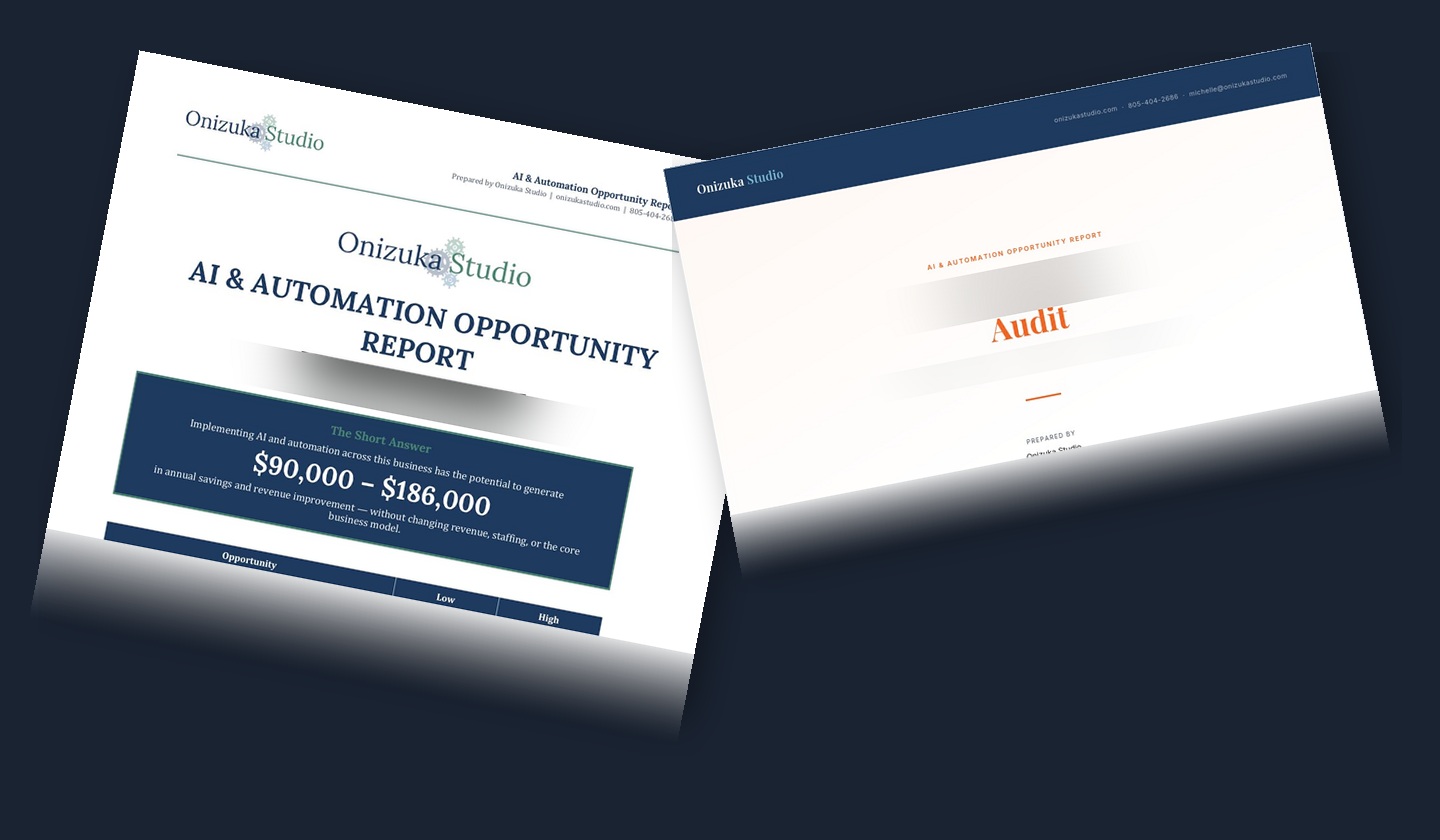
The Working Report
The complete record of the engagement — every finding, every decision, every build note, from the initial audit through the final implementation. It evolves with the project so nothing is ever lost or forgotten. When the project closes, you have everything: what we found, what we built, why we built it that way.
This is your answer to every future “why does it work this way?” question.
The Workflow Map
An interactive system schema showing every step, every automation, every trigger, every customization in the operation. Each element is clickable — it shows what it does, where it lives in the software, and how to access or change it. Direct links to every settings page in every application.
This is what replaces us. You don’t call us to find out where a setting lives. You open the map.
See a sample workflow map →The report covers as many areas as your business has.
Not a fixed template. Every audit is scoped to what we actually find in your operation. Most surface 8 to 10 areas — some businesses have more, some have fewer. During discovery, we tell you exactly how many apply before you commit to anything.
Ready to see what yours looks like?
Start free, start with your industry, or go straight to the roadmap. All three get you real answers before you spend a dollar on a full engagement.
Want the full version? See the Automation Audit →